As Unredacted evolved from a research project into an interactive installation, one of the most important design challenges was deciding what stories the work would tell.
My research focused on civic engagement, media literacy, public trust, and democratic participation in our current fragmented information environment. Certain ideas appeared again and again. People were trying to make sense of a constant flow of information while also understanding their rights, evaluating sources, managing uncertainty, connecting with others, and finding meaningful ways to participate in their communities.
From that came my desire to create an interactive visitor journey through these themes. Unredacted attempts to explore civic engagement as a process: noticing information, evaluating it, reflecting on its implications, and ultimately deciding how to respond.
From that process, ten themes emerged:
Signals
Verify
Trust
Systems
Rights
Anxiety
Engage
Create
Mobilize
Support
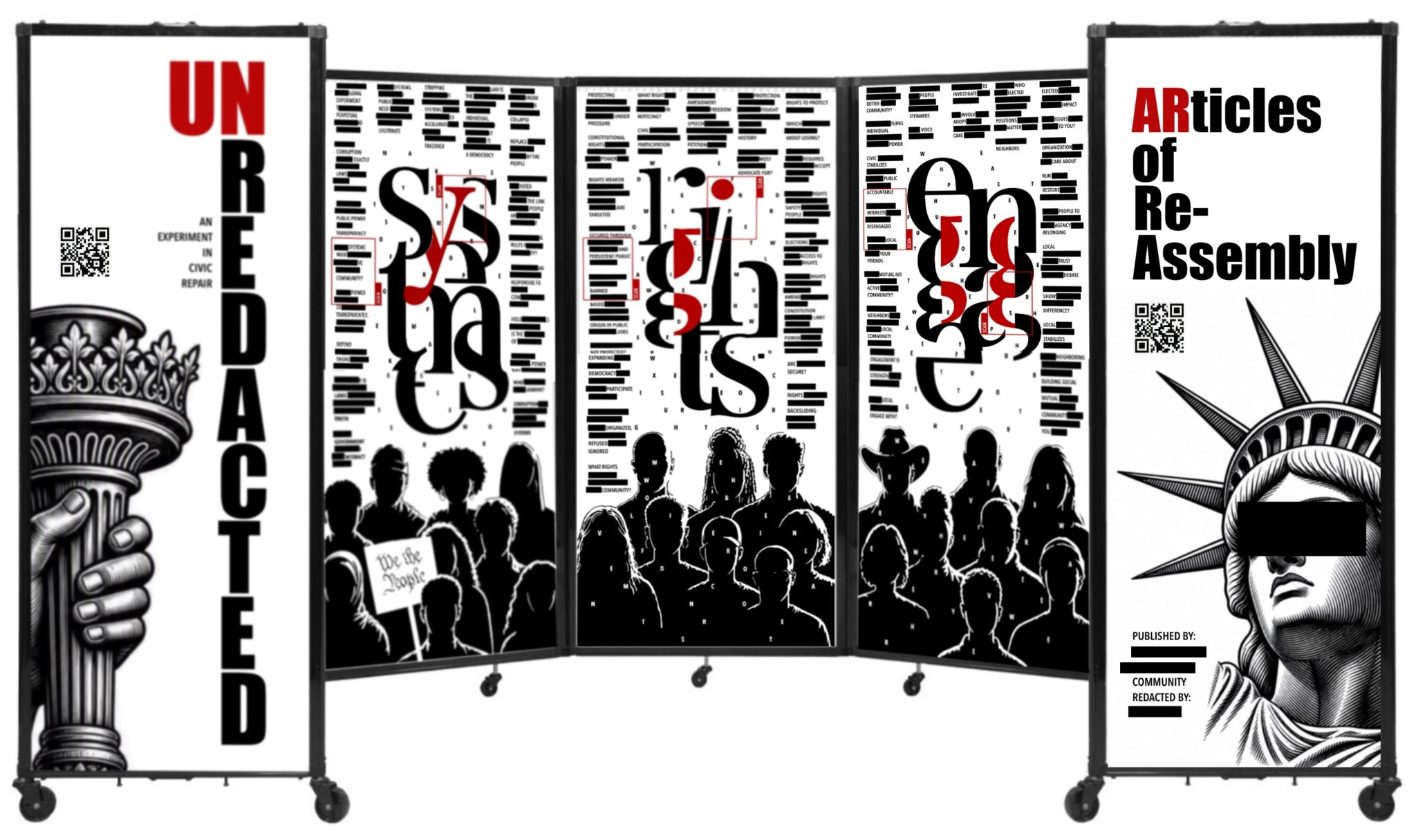
Together, the panels create a progression that follows a civic decision-making journey:
1. Notice information
2. Verify it
3. Decide what to trust
4. Understand systems
5. Reflect on rights
6. Acknowledge concerns
7. Become involved
8. Imagine alternatives
9. Act collectively
10. Sustain community
The sequence begins with awareness. Signals asks visitors to consider the messages, headlines, notifications, and information fragments that compete for attention every day. Verify encourages critical examination of those signals, inviting visitors to question sources, seek context, and evaluate credibility. Trust then explores how people determine what and whom to believe in an increasingly complex information environment.
From there, the installation expands outward to larger civic structures. Systems examines the visible and invisible networks that shape daily life, while Rights encourages reflection on the protections, responsibilities, and civic principles that underpin democratic participation.
The experience then shifts toward the emotional dimensions of civic life. Anxiety acknowledges feelings of uncertainty, frustration, and overwhelm that often accompany engagement with public issues. Rather than treating these emotions as obstacles, the panel recognizes them as part of the lived experience of navigating contemporary civic life.
The final four panels focus on participation and possibility. Engage explores ways people connect with issues and communities. Create invites visitors to imagine alternatives and contribute their own ideas, stories, and perspectives. Mobilize considers how individuals move from personal reflection to collective action. Finally, Support highlights the networks of care, collaboration, and mutual aid that help communities endure and thrive.
Developing these themes helped establish the conceptual framework for the entire project. Every panel would eventually include its own visual language, interaction prompts, and augmented reality experiences. Together, the ten panels move from observation to action, encouraging visitors to consider not only how they encounter civic information, but how they might respond to it.
While each theme stands on its own, none exists in isolation. Verification influences trust. Systems shape rights. Anxiety affects participation. Creation can inspire mobilization. Support helps sustain civic action over time. The relationships between the themes became just as important as the themes themselves.
Identifying the ten panel themes was the moment when Unredacted began to take shape as a cohesive experience. The themes transformed a broad body of research into a structured visitor journey, providing the foundation for everything that followed, from screenprinted panels and AR interactions to participant contributions and personalized civic artifacts.